
A day trip to Sintra
2026-02-17
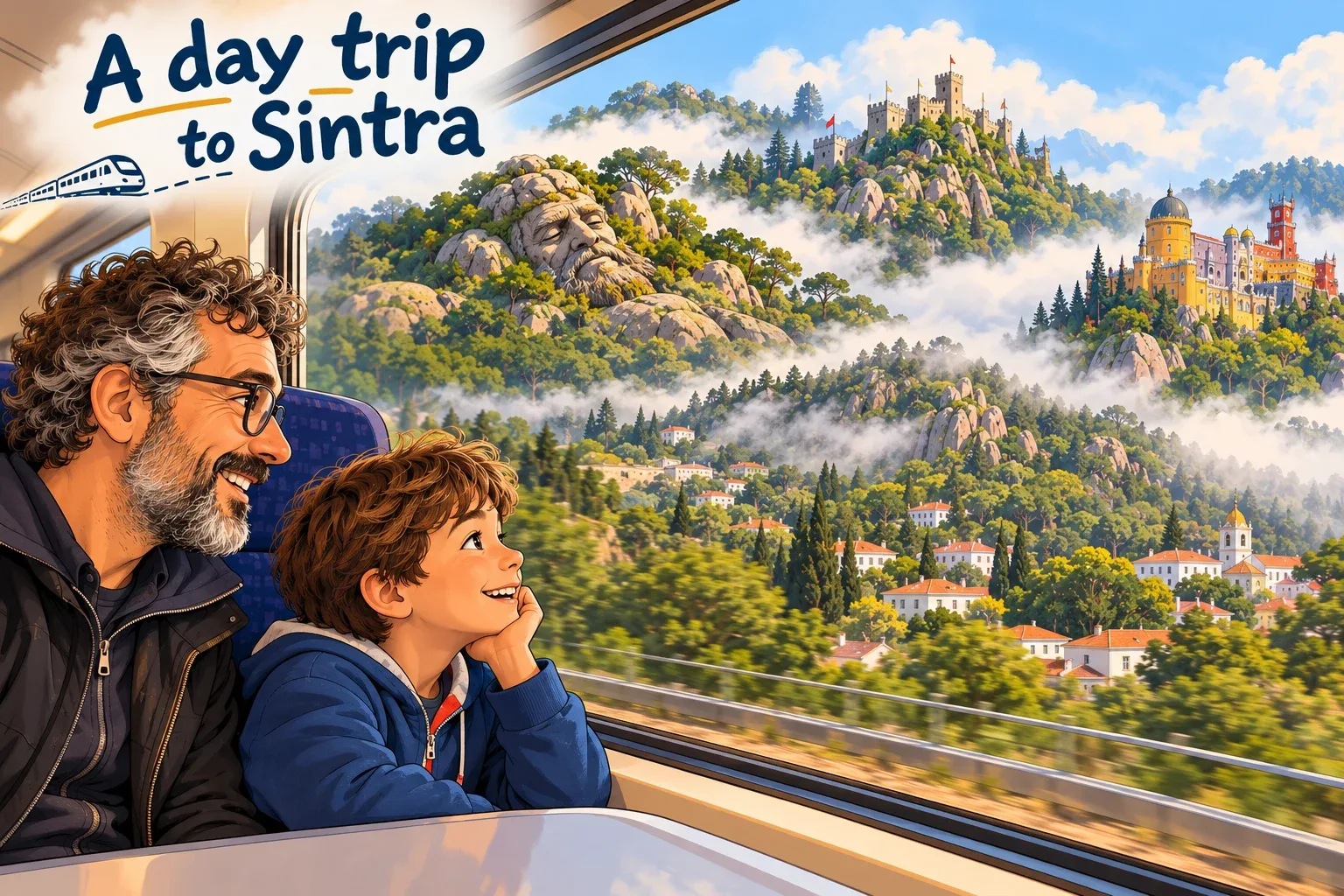
In February 2026 my son and I took the train to Sintra, for a day out with my nephew and my two great-nephews. Somewhere along the line the houses thin out and the hills start to show, usually with a bit of mist on top. That’s when I gave him the story below. The giant and some of the legends are made up, but the rocks and the trees are real.
Have a good look out the train window. See how the view is changing? The houses are falling behind, and suddenly there’s a mountain wrapped in fog, as if it were hidden by a spell. This train isn’t just taking us to a town. It’s our time machine.
The giant who didn’t want to be a volcano
A long, long time ago, long before there were kings or castles, even before the dinosaurs disappeared (about 80 million years ago), something magical happened under the ground we’re on now. Imagine that, deep down, about five kilometres below, the heart of the Earth got very hot and made a bubble of fire called magma. That bubble wanted to rise, to burst out and become a noisy, destructive volcano.
But the Sintra hills are special. Instead of bursting out, the bubble decided to be patient. It stayed trapped underground, tucked under a blanket of softer rocks: limestone and sandstone. And there it stayed, cooling very, very slowly, for millions of years. Because it cooled without hurrying, the fire turned into crystals. Every little piece of granite you’ll see today is really a team of tiny crystals of quartz, feldspar and mica that grew together, hugging each other, to make the strongest rock in the world, one that can stand millions of years of rain and wind.
Then the rain and the wind, as if they were unwrapping a present, slowly cleared away the earth on top until the Granite Giant came out. That’s why the hills have these rounded shapes, like the bones of a giant who fell asleep looking out to sea.
The promise of the little stone
You asked if you could take a little stone home, didn’t you? Imagine if every knight, every prince and every child who has visited Sintra in the last thousand years had put a stone in their pocket. If everyone did that, the Granite Giant would end up disappearing!
Sintra’s stones are the keepers of its memories. They felt the swords of the Moors and the footsteps of the first King of Portugal. If you leave yours there, it stays part of the story. But I’ve got a better idea: let’s find the most beautiful stone, take a photo of it or draw it, and leave it there to keep our secret. Then, when you come back in many years, it’ll still be there waiting for you, like an old friend.
The moon’s sentinels and the castle in the clouds
About a thousand years ago, warriors from very hot lands in North Africa, the Moors, came to these hills. They looked up at the top of the mountain and thought: “This is where we’ll build our eagle’s nest.” They called the place Xintara, which means something like the Star, or the Moon. Long before them, the Romans had already called it the Mountain of the Moon.
They climbed the granite boulders (the ones the giant left behind) and, stone upon stone, built the walls you’re going to see today: the Castle of the Moors. They had no machines, only the strength of their arms and the wish to protect their families. From up on those walls they could see if a ship was coming in from the sea or if someone was crossing the plain. They really did live in the clouds! When the fog rolled up, the castle vanished from the world, and the Moors looked like ghosts guarding the mountain.
Afonso Henriques and the crystal knight
But the story didn’t stop there. In 1147 the first King of Portugal, Afonso Henriques, a very tall and brave knight, had just conquered Lisbon, and he decided that Sintra had to be part of the new kingdom. Legend has it he didn’t win the castle with swords alone, but with courage.
One morning, as the sun began to strike the granite and make the crystals in the rock sparkle, the Moors understood that their time on the mountain was over. The Portuguese knights rode in through the gates. Not every story about castles needs a battle.
From then on, Sintra became the secret garden of the kings and queens of Portugal. They came here to escape the heat of Lisbon and to listen to what the forest had to say.
The artist king and the travelling trees
Now get ready, because this is the most amazing part. In 1838, almost two hundred years ago, a prince from Germany called Ferdinand, who had married the Queen of Portugal and become King Ferdinand II, came up the mountain. He wasn’t an ordinary prince: he was an artist who loved nature. When he saw the ruins of an old monastery up on the hills, instead of feeling sad, he started to dream.
Ferdinand decided Sintra had to have the most beautiful forest in the whole world. He wrote letters to every corner of the planet: to America, to Australia, to China and to Japan. “Send me your rarest and strongest trees!” he asked.
And so they came: seeds of giant sequoias from North America that live for hundreds, even thousands, of years; tree ferns from Australia and New Zealand that look like trees from another planet; Japanese cedars that smell of paradise, and ginkgos from China. He planted them all around the granite boulders, making an enchanted forest, the Pena Park, where trees from different continents live side by side like neighbours. When we’re walking up there, try hugging a tree. Some of them are so old they were already there when your great-great-grandparents were born!
The Pena Palace: the castle of the sleeping prince
At the very top, on the highest point of all, Ferdinand built the Pena Palace. But he didn’t want a grey, boring palace. He wanted a palace that looked like a dream! He painted it yellow like the sun and red like fire. He gave it towers of every shape, shiny tiles and windows like eyes watching over the forest.
To many people, the Pena Palace looks like the castle of an enchanted prince who was lost in time and suddenly woke up in the middle of the trees. It’s a place where imagination is in charge. There are stone monsters guarding the doors (the Triton!), there are secret passages, and there’s a view that makes us feel we own the horizon.
Our challenge
Soon we’ll get off the train and start climbing. I want you to keep an eye out for three things:
- the crystals in the granite (look for the ones that sparkle most!);
- the smell of the trees that came from far away;
- the walls the Moors built up in the clouds.
We’re nearly there. Ready to step into the story?